Piano Keys Labeled: Note Names for All 88 Keys
A full-size piano has 88 keys: 52 white and 36 black, from A0 at the far left to C8 at the far right. The white keys are named with the letters A to G, and each black key is named as a sharp or a flat of the key beside it. The chart below labels all of them, and the keyboard further down lets you hear any key and read its name. No download, no sign-up.
All 88 piano keys, labeled

How piano key names work
The white keys use seven letters, A B C D E F G, and then repeat: after G comes A again, one octave higher. An octave is the distance from one note to the next note with the same letter, such as C4 to C5, and it covers 12 keys counting both white and black.
The black keys come in groups of two and three, because there is no black key between E and F or between B and C. The white key just to the left of a group of two black keys is always C, which makes it easy to find your place on any keyboard. Each black key is named after the white key beside it: it is a sharp (♯) of the white key on its left and a flat (♭) of the white key on its right. The black key between C and D is C♯ or D♭, and the two names mean the same key.
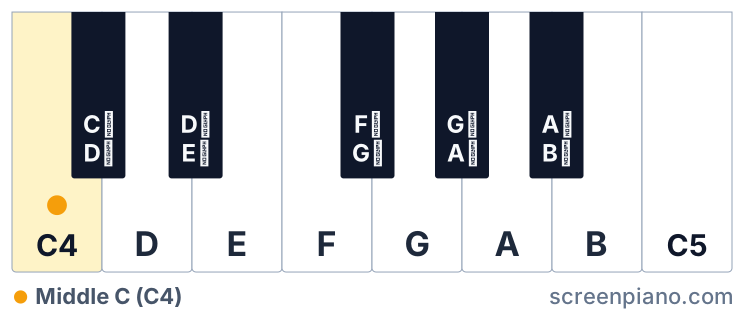
Octave numbers change at C, not at A, so B3 is the key just below C4. Middle C, near the centre of the keyboard, is C4 in scientific pitch notation, the system used on this page. It is key 40 of 88, counting from the left. Some brands number octaves differently: Yamaha, for example, calls middle C “C3”, so check which system a manual uses before comparing note names.
Click a key to hear its name
Click or tap a key to hear it. The readout shows the note name, the key’s number counted from the left of an 88-key piano, and its pitch in hertz. The buttons move the keyboard along the piano: the first range reaches the three lowest keys, A0, A#0 and B0, and the last one reaches C8.
Keys shown
C4 middle C
Key 40 of 88 · 261.63 Hz
Piano key names by octave
The same chart as text, so you can search it, copy it or read it with a screen reader. Black keys list the sharp name first and the flat name second. Octave 0 has only A0, A#0 and B0, octave 8 has only C8, and middle C (C4) is key 40.
| Octave | White keys | Black keys (sharp / flat) | Key numbers |
|---|---|---|---|
| 0 | A0 B0 | A#0/Bb0 | 1–3 |
| 1 | C1 D1 E1 F1 G1 A1 B1 | C#1/Db1D#1/Eb1F#1/Gb1G#1/Ab1A#1/Bb1 | 4–15 |
| 2 | C2 D2 E2 F2 G2 A2 B2 | C#2/Db2D#2/Eb2F#2/Gb2G#2/Ab2A#2/Bb2 | 16–27 |
| 3 | C3 D3 E3 F3 G3 A3 B3 | C#3/Db3D#3/Eb3F#3/Gb3G#3/Ab3A#3/Bb3 | 28–39 |
| 4 | C4 D4 E4 F4 G4 A4 B4 | C#4/Db4D#4/Eb4F#4/Gb4G#4/Ab4A#4/Bb4 | 40–51 |
| 5 | C5 D5 E5 F5 G5 A5 B5 | C#5/Db5D#5/Eb5F#5/Gb5G#5/Ab5A#5/Bb5 | 52–63 |
| 6 | C6 D6 E6 F6 G6 A6 B6 | C#6/Db6D#6/Eb6F#6/Gb6G#6/Ab6A#6/Bb6 | 64–75 |
| 7 | C7 D7 E7 F7 G7 A7 B7 | C#7/Db7D#7/Eb7F#7/Gb7G#7/Ab7A#7/Bb7 | 76–87 |
| 8 | C8 | none | 88 |
How many keys do keyboards have?
Acoustic pianos have 88 keys. Digital pianos and keyboards also come with 76, 61, 49 or fewer keys. A smaller keyboard is a section of the same layout, so the note names do not change: a key is still C4 wherever it sits.
| Keys | Usual range | Span | White / black | Middle C is key |
|---|---|---|---|---|
| 88 | A0–C8 | 7 octaves and a minor third | 52 / 36 | 40 |
| 76 | E1–G7 | 6 octaves and a minor third | 45 / 31 | 33 |
| 61 | C2–C7 | 5 octaves | 36 / 25 | 25 |
| 49 | C2–C6 | 4 octaves | 29 / 20 | 25 |
These are the usual ranges. Some models start or end a few notes differently, and keyboards with 25 or 37 keys vary even more, so check the manual of yours.

On a wide screen the ScreenPiano keyboard shows the same 61-key range, C2 to C7. You can pick another size, up to the full 88 keys, in Settings.
How do notes on the staff match the piano keys?
Sheet music writes notes on a staff of five lines. Where a note sits on the staff tells you which white key to play, and a sharp or flat sign in front of it means the black key beside that white key.
The treble staff, usually read by the right hand, has the lines E G B D F and the spaces F A C E, counting from the bottom. The bass staff, usually read by the left hand, has the lines G B D F A and the spaces A C E G. Middle C sits on a short extra line between the two staves.
| Staff | Lines | Spaces |
|---|---|---|
| Treble | E4 G4 B4 D5 F5 | F4 A4 C5 E5 |
| Bass | G2 B2 D3 F3 A3 | A2 C3 E3 G3 |
Every note in the table is a white key on the chart above: find its letter and its octave number, then look for it on the keyboard. A common memory aid for the treble lines is “Every Good Boy Does Fine”, and for the bass lines “Good Boys Do Fine Always”.
Play these keys on ScreenPiano
To play with your computer keyboard, open the ScreenPiano virtual piano and turn on note names in Settings if you want them printed on the keys. The keybinds chart shows which computer key plays which note. To hear chords built from these keys, see the piano chord chart. For tunes written in letter notes, browse the easy piano songs. To check whether you can name a note by ear, take the perfect pitch test.
Piano key questions
How many keys does a piano have?
A full-size piano has 88 keys: 52 white and 36 black. They run from A0 to C8 and cover 7 octaves and a minor third.
How many white keys and black keys are there on a piano?
There are 52 white keys and 36 black keys. Each full octave from C to B has 7 white and 5 black keys. The two ends are partial: the lowest octave has only A0, A#0 and B0, and the highest has only C8.
What are the lowest and highest keys on a piano?
The lowest key is A0, at about 27.5 Hz, and the highest is C8, at about 4,186 Hz.
How do I find middle C?
Find the group of two black keys closest to the centre of the keyboard and press the white key just to its left. That is middle C, written C4. On an 88-key piano it is key 40 from the left, and the fourth C counting up from the bottom.
Why are the black keys in groups of two and three?
There is no black key between E and F, or between B and C. In each octave that leaves a group of two black keys (C♯ and D♯) and a group of three (F♯, G♯ and A♯), and the gaps make the groups handy landmarks.
Are C♯ and D♭ the same key?
On a piano, yes. They are two names for one key, and which one a piece of music uses depends on its key signature and the notes around it. The same goes for D♯ and E♭, F♯ and G♭, G♯ and A♭, and A♯ and B♭.
Is a 61-key keyboard enough to start?
For most beginner songs, yes. 61 keys give you 5 octaves, and a first piece rarely leaves the two octaves around middle C. Much classical piano music uses more than five octaves, so you may want 88 keys later.